
How to Develop Your Human Intelligence
Part 3 of 3: Human Intelligence in the AI Age

Where We’ve Been
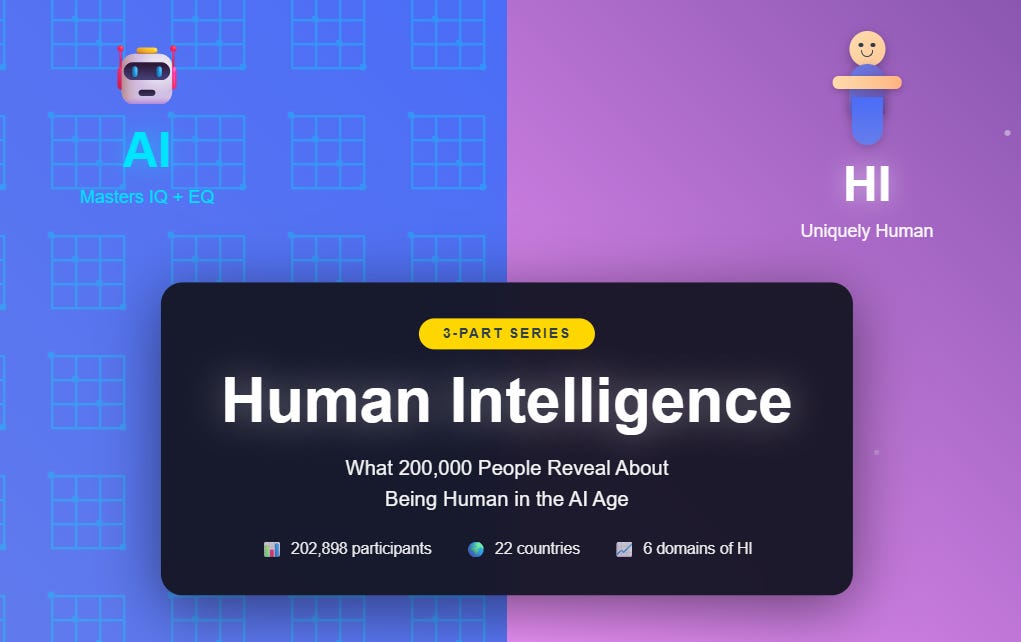
In Part 1, we discovered the paradox: countries with highest financial security score lowest on meaning.
Japan ranks #1 in wealth but #22 in meaning. The data from 202,898 people revealed what actually predicts flourishing and it’s not what we’ve been optimizing for.
In Part 2, we introduced Human Intelligence (HI): the six domains that make us irreplaceably human. Meaning and purpose. Character and virtue. Deep relationships. Wisdom and judgment. Spiritual capacity. Community belonging. These are learnable capacities that predict thriving more than IQ or income, and AI fundamentally cannot replicate them.
Now comes the practical question: How do you actually develop Human Intelligence?
You can assess where you are, pick one domain to focus on, and start building capacity this week. Ready to assess your Human Intelligence?
Take the Interactive HI Assessment https://sheleads360.com/hi-assessment
Prefer to assess offline? Scroll down for the written version below.
Assess Your HI
Start with honest assessment. Rate yourself 0 to 10 on each domain using these questions:
Meaning and Purpose
Do you know what you’re living for beyond survival?
Does your daily life reflect your deepest values?
0 = No idea what I’m living for, just getting through days
10 = Crystal clear on my purpose, life reflects my deepest values
Your score: ___
Character and Virtue
When faced with difficult choices, do you consistently choose according to your values?
Are you becoming who you want to be?
0 = I regularly compromise my values when it’s hard
10 = I consistently act with integrity even when it costs me
Your score: ___
Deep Relationships
Do you have 2-3 people who genuinely know you?
Are you showing up authentically in relationships?
0 = No one really knows me; I perform roles
10 = Multiple people know the real me; authentic connections
Your score: ___
Wisdom and Judgment
Can you distinguish urgent from important?
Do you think in decades when making decisions?
0 = Reactive, always chasing urgent, short-term thinking
10 = Clear on what matters, consistently choose important over urgent
Your score: ___
Spiritual Capacity
Do you feel connected to something larger?
Do you have grounding practices?
Do you experience awe?
0 = No sense of transcendence, no practices, rarely feel awe
10 = Regular spiritual practice, frequent awe, deep sense of connection
Your score: ___
Community Belonging
Are you part of communities that matter?
Do you feel you belong somewhere?
0 = No real community, feel isolated
10 = Strong belonging in multiple communities, feel valued and known
Your score: ___
Your Starting Point
Look at your six scores. Notice patterns:
Which domains are strongest? (These are your foundation)
Which are weakest? (These are your growth edges)
Are any scores surprising to you?
The rule: Pick one domain where you scored lowest. Just one.
That’s your focus for the next 12 weeks.
Development in Practice
Here’s what development looks like in each domain. Choose your weakest area and commit to one practice.
For Meaning and Purpose
Weekly reflection practice: Every Sunday evening, spend 15 minutes asking:
What did I do this week that actually mattered?
Why am I doing what I’m doing?
Does my daily life reflect what I say I value?
Write three sentences. Track patterns over weeks.
Why this works: Meaning doesn’t come from thinking about it once. It comes from regular examination of the gap between your stated values and your lived life. The reflection reveals where you’re drifting.
For Character and Virtue
Take on one difficult commitment: Something that requires sustained effort over 3-6 months. Something you can’t do just when you feel motivated.
Examples:
Daily exercise (when you don’t want to)
Weekly calls with aging parent (when it’s inconvenient)
Monthly volunteering (when you’re busy)
Learning a difficult skill (when it’s frustrating)
Keep it even when you don’t feel like it. That’s the point. Character builds through repetition of hard choices.
Why this works: Character isn’t knowledge. It’s habit. Moral muscle. You don’t build muscle by reading about exercise—you build it by doing hard things repeatedly until they reshape you.
For Deep Relationships
One vulnerable conversation weekly: Pick one relationship you want to deepen. Each week, have one conversation where you:
Share something real (not just logistics or small talk)
Ask questions that go beneath the surface
Risk being seen more fully
This isn’t about adding more relationships. It’s about deepening the ones you have.
Why this works: Relationships deepen through genuine exchange, not more time together. One vulnerable conversation per week for 12 weeks will transform a relationship more than years of surface-level contact.
For Wisdom and Judgment
Read philosophy, biography, and literature: Not productivity books. Not skills training. Texts that wrestle with big questions and show how people have navigated complexity.
Plus: Seek out elders. People 20+ years older who’ve lived through what you’re facing. Have conversations. Listen more than you speak.
Plus: Sit with big questions without rushing to answers. When faced with a difficult decision, resist the urge to solve it immediately. Let it sit for a week. Journal it.
Why this works: Wisdom is integrated experience. You’re borrowing the lived wisdom of others through their stories and wrestling with questions that don’t have easy answers. Wisdom grows slowly, through engagement with complexity.
For Spiritual Capacity
Establish one daily practice: Ten minutes. Same time each day. Choose one:
Prayer (if you’re religious)
Meditation (if you’re secular)
Journaling (if you’re reflective)
Walking in nature (if you’re kinesthetic)
Consistency matters more than duration. Ten minutes daily for 90 days > occasional hour-long sessions.
Plus: Deliberately seek awe weekly. Go somewhere that makes you feel small. Watch something that reminds you life is bigger than your to-do list.
Why this works: Spiritual capacity is like a muscle. It atrophies without use. Regular practice, even brief, maintains the connection.
For Community Belonging
Show up. Then show up again. Then keep showing up.
Join one community that meets regularly (examples):
Religious community
Volunteer organization
Sports league / running group
Book club / discussion group
Neighborhood association
Go for 12 weeks straight, no matter what. Early weeks will feel awkward. By week 8, people know your name. By week 12, you belong.
Contribute. Don’t just consume. Offer to help. Bring snacks. Set up chairs. Small acts of service accelerate belonging.
Why this works: Belonging develops through sustained presence + contribution. You can’t belong to something you show up to sporadically. Consistency signals “I’m one of you.”
The AI Advantage
Here’s where AI actually helps with HI development. Use AI to reclaim time for what makes you irreplaceably human:
Let it draft emails
Summarize documents
Analyze data
Generate first drafts
Handle routine cognitive tasks
Consider this:
If AI saves you 10 hours/week...
How many go to scrolling vs. relationships?
How many go to consumption vs. meaning-making?
How many go to efficiency vs. wisdom development?
The Intelligence That Matters
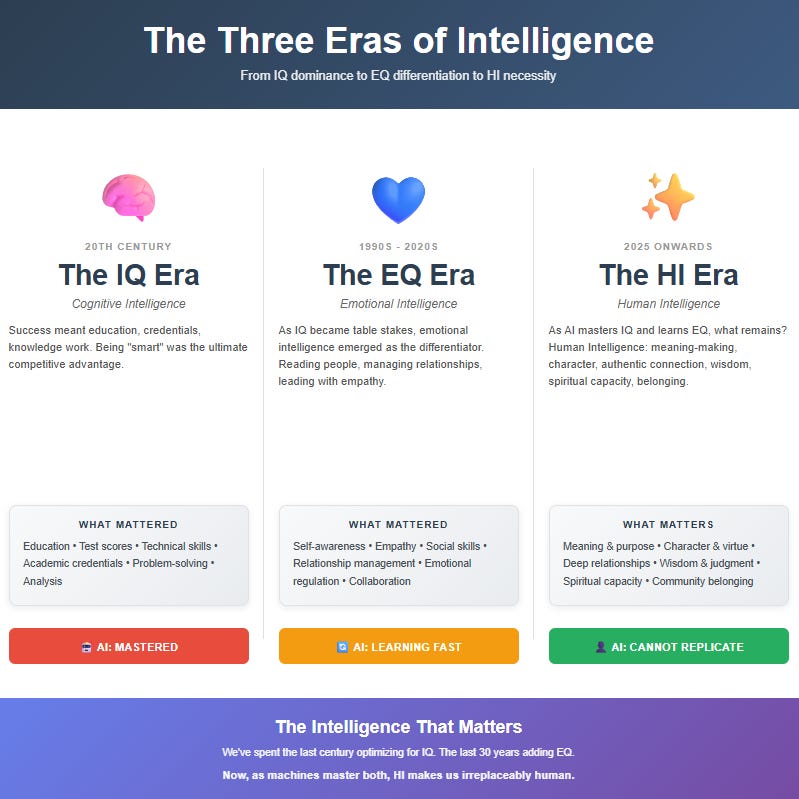
We’ve lived through three eras of intelligence:
The IQ Era dominated the twentieth century. Success meant education, credentials, knowledge work. Being smart mattered most.
→ AI: Mastered. Machines do IQ tasks better than we ever could.
The EQ Era emerged in the 1990s and carried through the 2020s. Emotional intelligence became the differentiator. Reading people, managing relationships, leading with empathy.
→ AI: Learning fast. Not perfectly, but well enough for many purposes.
We’re entering the HI Era. Human Intelligence is what remains. Meaning-making, character development, authentic connection, wisdom, spiritual capacity, genuine belonging.
→ AI: Cannot replicate.
The study of 202,898 people across 22 countries confirms what ancient wisdom already knew: these capacities predict flourishing more than cognitive skills or material wealth.
AI can be a great thing that helps humanity. It can free us from cognitive drudgery. It can create wealth and abundance.
But only if we use that freedom and wealth to develop what makes us irreplaceably human.
Use AI to free time for what actually matters.
More humanity.
The machines are getting better at being machines. Our work is to get better at being humans.
This is Part 3 of a 3-part series on Human Intelligence in the AI Age.
Read Part 1: “The Meaning Paradox: What 200,000 People Reveal About Wealth vs. Fulfillment”
Read Part 2: “Introducing Human Intelligence: The Six Domains AI Can’t Touch”
SheLeads360™ | EQ + HI Strategist | Human + AI Leadership | Wellbeing Clinician
Elevating leaders to scale in business and life.
Follow me for more Human Intelligence insights, strategies for thriving in the AI age, and practical frameworks for developing the capacities that make you irreplaceably human.
Study Citation: VanderWeele, T.J., Johnson, B.R., et al. (2025). “The Global Flourishing Study: Study Profile and Initial Results on Flourishing.” Nature Mental Health, 3, 636–653.