
Introducing Human Intelligence: Six Domains AI Can’t Touch
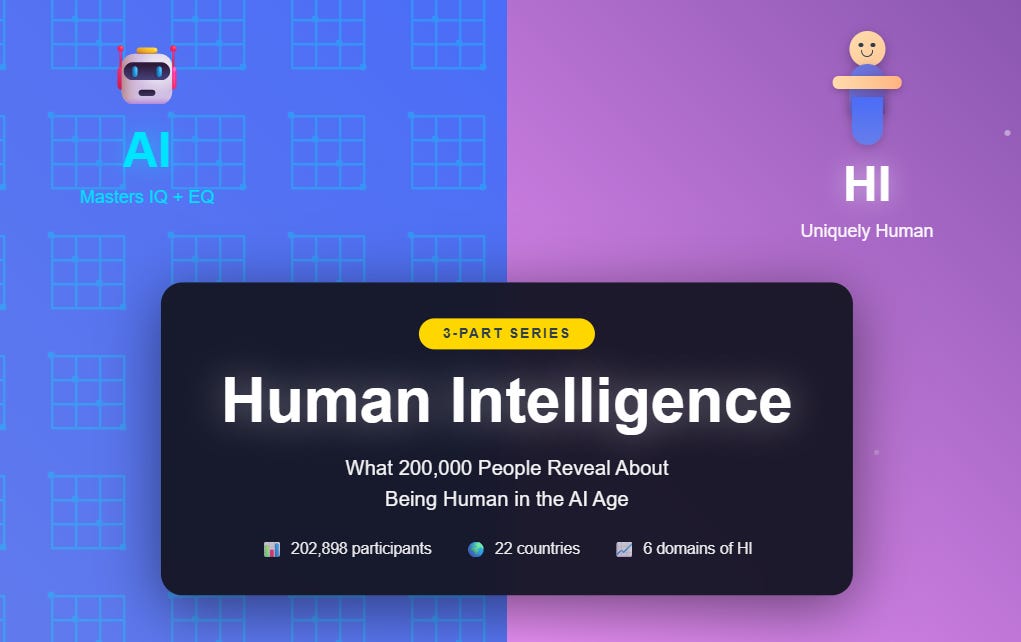
Part 2 of 3: Human Intelligence in the AI Age

In Part 1, we discovered a paradox: countries with the highest financial security score lowest on meaning and purpose.
Japan ranks #1 in wealth but #22 in meaning. Indonesia shows the opposite with #18 in financial security but #1 in meaning.
We also learned what predicts human flourishing:
ü Religious service attendance matters more than education level.
ü Marriage matters more than income.
ü Childhood relationships echo for 40+ years.
ü Community belonging beats political voice.
AI is getting brilliant at the things that do not predict flourishing: information processing, pattern recognition, logical analysis, task completion.
Meanwhile, the things that do predict flourishing are precisely what AI cannot do.
Where We Went Wrong
We built civilization around IQ and neglected HI.
- Education prioritizes test scores, not character.
- Work prioritizes productivity, not wisdom.
- Society tracks GDP, not flourishing.
We became IQ-rich and HI-poor
Developed nations show high cognitive development but lower meaning, purpose, and relationship strength.
Young people are struggling globally because they were educated for jobs that AI is now automating; they were not educated to develop the capacities that predict thriving.
AI can free 10–20 hours per week. That time could support HI development.
Instead, we (so far) fill it with consumption, distraction, and shallow productivity. The gap widens.
This gap is called Human Intelligence (HI)
Human Intelligence is the capacity for meaning-making, authentic connection, character development, wisdom, and belonging.
IQ is cognitive intelligence. EQ is emotional intelligence. HI is something deeper.
HI includes:
- Asking why your life matters
- Developing virtues through struggle
- Building reciprocal relationships
- Exercising moral judgment in context
- Feeling connected to something larger
- Becoming part of communities that shape identity
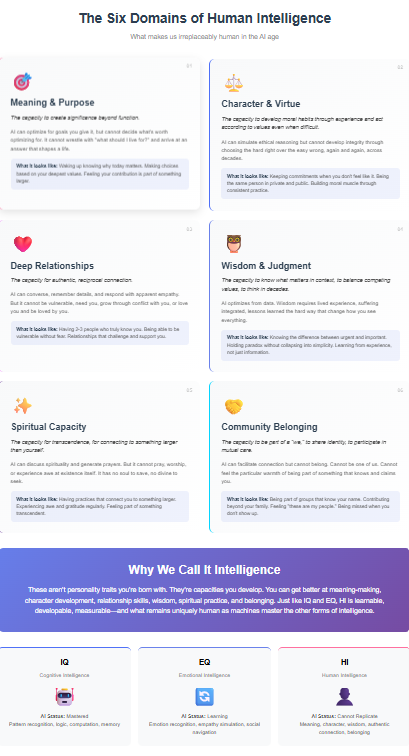
This is further defined in the Six Domains of Human Intelligence:
1. Meaning and Purpose - The capacity to create significance beyond function. Countries differ widely, but data shows meaning drives resilience, aligned decisions, and lower depression. AI cannot determine what is worth optimizing for.
2. Character and Virtue - The capacity to develop moral habits and act on values even when difficult. Character forms through repetition and integrity. AI can simulate ethics but cannot develop it.
3. Deep Relationships - The capacity for authentic, reciprocal connection. Relationships predict flourishing more than income. AI cannot be vulnerable or experience mutual growth.
4. Wisdom and Judgment - The capacity to balance competing values and think long-term. Wisdom comes through lived experience and reflection. AI cannot internalize lessons through suffering or growth.
5. Spiritual Capacity - The capacity for transcendence and connection to something larger. AI cannot experience awe, pray, worship, or contemplate existence.
6. Community Belonging - The capacity to be part of a “we.” Belonging predicts resilience, generosity, and well-being. AI cannot belong.
Why We Call It Intelligence
Because these domains are capacities you develop, through being human.
- Meaning-making improves through reflection.
- Character through commitment.
- Relationships through vulnerability.
- Wisdom through integration.
- Spiritual capacity through practice.
- Belonging through consistent participation.
HI is learnable, developable, measurable and best of all - uniquely human.
Unless we learn, develop and measure HI, AI will accelerate a future of wealthy emptiness.
Use AI to create space for what makes you irreplaceably human.
Coming up in Part 3 - evaluate your six domains with our interactive tool.
This is Part 2 of a 3-part series on Human Intelligence in the AI Age.
Part 3: “How to Develop Your Human Intelligence” will be release on December 15th.
Follow for the rest of the series and more insights on human behavior, leadership, life and wellbeing. https://substack.com/@sheleads360 sheleads360.com
SheLeads360™ | EQ CBT REBT CBT-I | Human Intelligence + AI | Wellbeing Clinician
Study citation: VanderWeele, T.J., Johnson, B.R., et al. (2025). “The Global Flourishing Study: Study Profile and Initial Results on Flourishing.” Nature Mental Health, 3, 636–653.